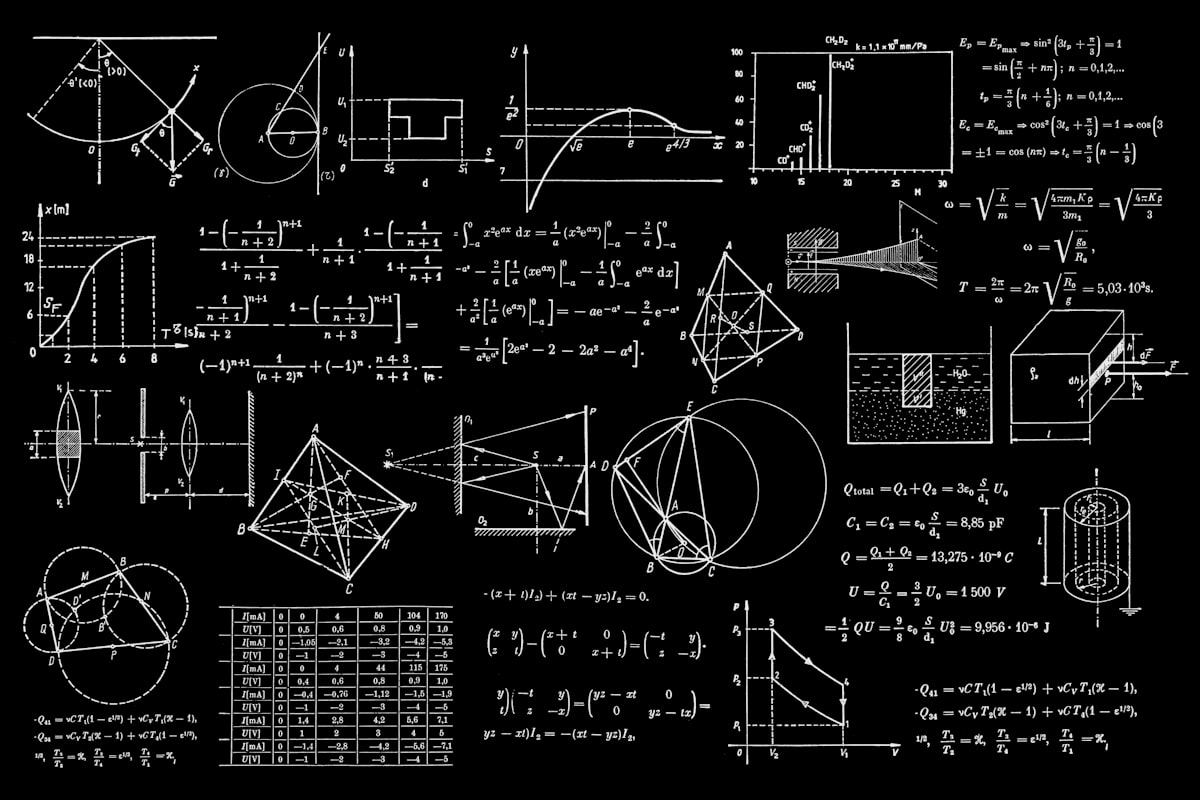
This post demonstrates mathematical notation rendering using KaTeX.
Inline Math
You can write inline math like this: E=mc2, or the quadratic formula: x=2a−b±b2−4ac.
The area of a circle is A=πr2, and the Pythagorean theorem states that a2+b2=c2.
Display Math
x=2a−b±b2−4ac
Summation
i=1∑ni=2n(n+1)
Integration
∫abf(x)dx=F(b)−F(a)
Matrix
[acbd][xy]=[ax+bycx+dy]
Limits
x→∞limx1=0
eiπ+1=0
Taylor Series
f(x)=f(a)+f′(a)(x−a)+2!f′′(a)(x−a)2+3!f′′′(a)(x−a)3+⋯
f^(ξ)=∫−∞∞f(x)e−2πixξdx
Maxwell’s Equations
∇⋅E∇⋅B∇×E∇×B=ϵ0ρ=0=−∂t∂B=μ0J+μ0ϵ0∂t∂E
Probability and Statistics
Normal Distribution
f(x)=σ2π1e−21(σx−μ)2
Bayes’ Theorem
P(A∣B)=P(B)P(B∣A)⋅P(A)
Calculus
Chain Rule
dxd[f(g(x))]=f′(g(x))⋅g′(x)
Product Rule
dxd[u(x)⋅v(x)]=u′(x)⋅v(x)+u(x)⋅v′(x)
Linear Algebra
Eigenvalue Equation
Av=λv
Determinant
det(A)=acbd=ad−bc
Special Functions
Gamma Function
Γ(n)=(n−1)!=∫0∞tn−1e−tdt
Binomial Coefficient
(kn)=k!(n−k)!n!
Greek Letters and Symbols
Common symbols: α, β, γ, Δ, Σ, Ω, θ, ϕ, ψ
Operators: ≤, ≥, =, ≈, ∞, ∂, ∇
Conclusion
KaTeX supports a wide range of mathematical notation and renders beautifully in the browser!